Tennis was and still is an important part of my steel life. And this holds true also to many of my former steel colleagues who also got hooked in this beautiful game.
Tennis was introduced to us at National Steel Corporation (Iligan City, Philippines) sometime in the early 1980's by the then newly appointed NSC President, Jose Ben R. Laraya, JBL to us. Many of us, men and ladies, instantly got hooked that the first tennis court built was just not enough to accommodate these budding and aspiring tennis players.
It's funny to recall that we would quarrel, argue, or what not on the time slot, pairings, etc. On Saturdays, some would camped out overnight just so they would have the first crack of slot the next day. Then, another court was added. Still it wasn't enough. By then, tournaments were held on different class levels. We were then in awe and got inspired by the first class players every time they played. Bettings, in kind or cash, was not unusual.
Everytime JBL would come to Iligan, tennis in the evenings was a required schedule. Meetings were adjourned at 6pm and would resume after he would finish playing. At first, he played against the other managers and executives. But as a serious competitor himself, he could not somehow get satisfaction from these officers with their limited skills to match his and his passion to a good, real tennis game. In due time, he chose the first-class players as his partners and opponents where he could really enjoy the game. That time, too, tennis, together with other sports, like NBA, would be our language, in and out of work.
On rainy days, JBL and us got disappointed. So he approved the construction of a roof where we could play anytime and uninterrupted, come rain or shine. We were proud to say then that our shell clay court was the best tennis court in Mindanao. Then a third court was added.
Around Iligan, tennis also flourished. Big games were held in Bacayo Courts in Rosario Heights, in Benitez courts in Palao, In mSU-IIT, in Sanitarium hospital, in Tubod, etc. Camoy Palahang, who later became a stand out in the Philippine team was just then a promising young boy. Many outstanding players were noticed. Surprisingly, they came from towns in Linamon, Tubod, Bacolod, Kapatagan, and even across Misamis Oriental.
It was the era of Borg and McEnroe, then Lendl and Wilander, Becker. Until Agassi and Sampras came. For women, there was Navratilova, Austin, Seles and my favorite, Steffi Graf. Now it's Federer, Nadal, Murray, and company. In the women's draw, the Williams sisters, Henin, Cljisters, Sharapova, Ivanovic, Safina, Dementieva and other Russian ladies.
Tennis is indeed royalty. I do not play it anymore, though I hope I could in the near future. There is a tennis court near our neighborhood and it's just a matter of going back to it. Meantime, I do not miss the games on TV especially the Grand slam events. I grew up with it as I grew up in my world of steel.
Wednesday, July 8, 2009
Monday, June 29, 2009
Michael Jackson, The Steelworker's Son
I was surprised to learn from CNN that the father of Michael Jackson, the man who drove them to music, is a retired steel worker. And when it was further revealed that he was born in Gary, Indiana, wow, I said to myself, there goes Michael Jackson's steelconnect.
I could easily surmised that Joe Jackson, the father, had worked in US Steel, Gary Works. Fifteen miles from Gary Works is Bethlehem Steel, Burns Harbor Plant. This is where we stayed and trained from February 28 to May 9, 1986 in the operation of Blaw Knox 5 Std cold rolling mill which our company. In fact, days before our training ended, some of our co-trainees from the production group were allowed to visit the Gary Steel plant. When I learned that I was not included on the list to go there, I decided to visit my relatives in New Jersey. I took a Greyhound bus from Howard Johnson in Portage for a short trip to Chicago's O'Hare airport. I could not forget that ride, for I rode alone, and I remember too well where we made a one city stopover: Gary, Indiana.
Gary, Indiana is a steel city near the border of Illinois (near Chicago) and Indiana. It is in fact a city built by steel. It was named after Elbert H. Gary, then the president of US Steel who in 1900's, built this steel mill along the sand dunes of Lake Michigan. Soon after, four other big integrated steel mills, namely, US Steel, Bethlehem Steel, Inland Steel, LTV, and National Steel were built along the shoreline of Lake Michigan stretching 50 miles between the Illinois Stateline and Portage.

I have fond memories of this tiny county, Portage. During our stay there, our official address was 164 Oak Tree Park, Portage, Indiana, a subdivision of mobile houses where mostly retired and old Americans live.

In those early years of steelmaking, steel was king in Indiana. In its heyday, Gary Works accounts for a little more than half of US Steel group total operating production. For many years, it was also the center of automobile industry, not Detroit, Michigan whom we knew is home to the Big 3 auto companies.

I don't know if these steel mills are still there and operating. Starting in the 80's, US steel industry has declined and until now, it has not yet recovered to its once lofty position as one of the world's greatest steel manufacturer.
MJ's father, Joe Jackson, may have seen the writings on the wall early; just as we also experienced and felt in our days the downfall of National Steel Corporation. So he jumped ship and dedicated his time and effort to developing his children and making one of them, Michael Jackson, a music icon, a pop legend. How he pushed his son(s) to stardom is another story.
I could easily surmised that Joe Jackson, the father, had worked in US Steel, Gary Works. Fifteen miles from Gary Works is Bethlehem Steel, Burns Harbor Plant. This is where we stayed and trained from February 28 to May 9, 1986 in the operation of Blaw Knox 5 Std cold rolling mill which our company. In fact, days before our training ended, some of our co-trainees from the production group were allowed to visit the Gary Steel plant. When I learned that I was not included on the list to go there, I decided to visit my relatives in New Jersey. I took a Greyhound bus from Howard Johnson in Portage for a short trip to Chicago's O'Hare airport. I could not forget that ride, for I rode alone, and I remember too well where we made a one city stopover: Gary, Indiana.
Gary, Indiana is a steel city near the border of Illinois (near Chicago) and Indiana. It is in fact a city built by steel. It was named after Elbert H. Gary, then the president of US Steel who in 1900's, built this steel mill along the sand dunes of Lake Michigan. Soon after, four other big integrated steel mills, namely, US Steel, Bethlehem Steel, Inland Steel, LTV, and National Steel were built along the shoreline of Lake Michigan stretching 50 miles between the Illinois Stateline and Portage.

I have fond memories of this tiny county, Portage. During our stay there, our official address was 164 Oak Tree Park, Portage, Indiana, a subdivision of mobile houses where mostly retired and old Americans live.

In those early years of steelmaking, steel was king in Indiana. In its heyday, Gary Works accounts for a little more than half of US Steel group total operating production. For many years, it was also the center of automobile industry, not Detroit, Michigan whom we knew is home to the Big 3 auto companies.

I don't know if these steel mills are still there and operating. Starting in the 80's, US steel industry has declined and until now, it has not yet recovered to its once lofty position as one of the world's greatest steel manufacturer.
MJ's father, Joe Jackson, may have seen the writings on the wall early; just as we also experienced and felt in our days the downfall of National Steel Corporation. So he jumped ship and dedicated his time and effort to developing his children and making one of them, Michael Jackson, a music icon, a pop legend. How he pushed his son(s) to stardom is another story.
Sunday, June 28, 2009
Michael Jackson of My Time
It's not difficult to relate to the worldwide outpouring of grief and tributes to the fallen music icon whom they call the " king of pop". After all, he lived in my time and I grew up with his music and artistry. He was 5 and I was 8 when he started to anchor as lead singer of a "brothers act" known as the Jackson 5. The rest is history.
In my teenage years, we would mimic his falsetto voice and studied in guitar their songs which we would sing in private and in gatherings, including caroling. To cite my favorites, Happy, La la la Means I Love You, I'll Be There, Ben, Maybe Tomorrow, Music and Me, and of course Little Drummer Boy, and Give Love on Christmas Day which I would still sing every Christmas.
His One Day in your Life came out in my senior year in college, at the time when we were grappling with the thought that soon we'll be entering the real world and part with friends. His melancholic " Out of My Life" somehow reflected my own love life in those days, so how could I not feel sad and sentimental when now it is being played and replayed all over again?
Then came the 80's and by now going solo, Jacko hit the top. Discos were filled with his signature danceable hits, Billie Jean, Beat It, Thriller, the highest selling album of all time, with over 50 million sold out copies. To me he revolutionized or even originated the MTV.
As a young professional by then, we hooped and wooped it out. They say he broke up the barriers of race and culture, black and white, as his songs transcended all these. He also somehow broke up political ideologies. I was in Communist Soviet Russia in 1984, the year the Thriller album was released. Anything Western, including music, especially American were of course a disdain to the Communists. But I would often hear Billie Jean in the air waves, and that alone was already phenomenal.
Heal the World, the song he said he would dedicate to the Filipino people was a message universally addressed to the world (in addition to the 1984 We Are The World Single of USA for Africa which he and Lionel Richie and Quincy Jones composed). Heal the world, make it a better place for you and for me. This is the song which our group, Philipine Institute of Chemical Engineers (PIChE) , Iligan Bay (Philippines) Chapter sang with glee and passion during the fellowship night of the PIChE National Convention which we co hosted in Cagayan de Oro City.
I write this tribute to Michael Jackson, not the man (for I didn't like his private life) but the musical genius who had touched those of us who lived in his time. He was up there in the hierarchy of music legends, along with the other genius whom I adore, the Beatles.
We've been together for such long time in music. Now he's out of our lives. His was not a small way to change the world. We'll surely remember him and his place, one day in my, in your life.
In my teenage years, we would mimic his falsetto voice and studied in guitar their songs which we would sing in private and in gatherings, including caroling. To cite my favorites, Happy, La la la Means I Love You, I'll Be There, Ben, Maybe Tomorrow, Music and Me, and of course Little Drummer Boy, and Give Love on Christmas Day which I would still sing every Christmas.
His One Day in your Life came out in my senior year in college, at the time when we were grappling with the thought that soon we'll be entering the real world and part with friends. His melancholic " Out of My Life" somehow reflected my own love life in those days, so how could I not feel sad and sentimental when now it is being played and replayed all over again?
Then came the 80's and by now going solo, Jacko hit the top. Discos were filled with his signature danceable hits, Billie Jean, Beat It, Thriller, the highest selling album of all time, with over 50 million sold out copies. To me he revolutionized or even originated the MTV.
As a young professional by then, we hooped and wooped it out. They say he broke up the barriers of race and culture, black and white, as his songs transcended all these. He also somehow broke up political ideologies. I was in Communist Soviet Russia in 1984, the year the Thriller album was released. Anything Western, including music, especially American were of course a disdain to the Communists. But I would often hear Billie Jean in the air waves, and that alone was already phenomenal.
Heal the World, the song he said he would dedicate to the Filipino people was a message universally addressed to the world (in addition to the 1984 We Are The World Single of USA for Africa which he and Lionel Richie and Quincy Jones composed). Heal the world, make it a better place for you and for me. This is the song which our group, Philipine Institute of Chemical Engineers (PIChE) , Iligan Bay (Philippines) Chapter sang with glee and passion during the fellowship night of the PIChE National Convention which we co hosted in Cagayan de Oro City.
I write this tribute to Michael Jackson, not the man (for I didn't like his private life) but the musical genius who had touched those of us who lived in his time. He was up there in the hierarchy of music legends, along with the other genius whom I adore, the Beatles.
We've been together for such long time in music. Now he's out of our lives. His was not a small way to change the world. We'll surely remember him and his place, one day in my, in your life.
Labels:
Michael Jackson,
pop icon
Tuesday, April 21, 2009
The Beginning of My Journey to Steel (Life)
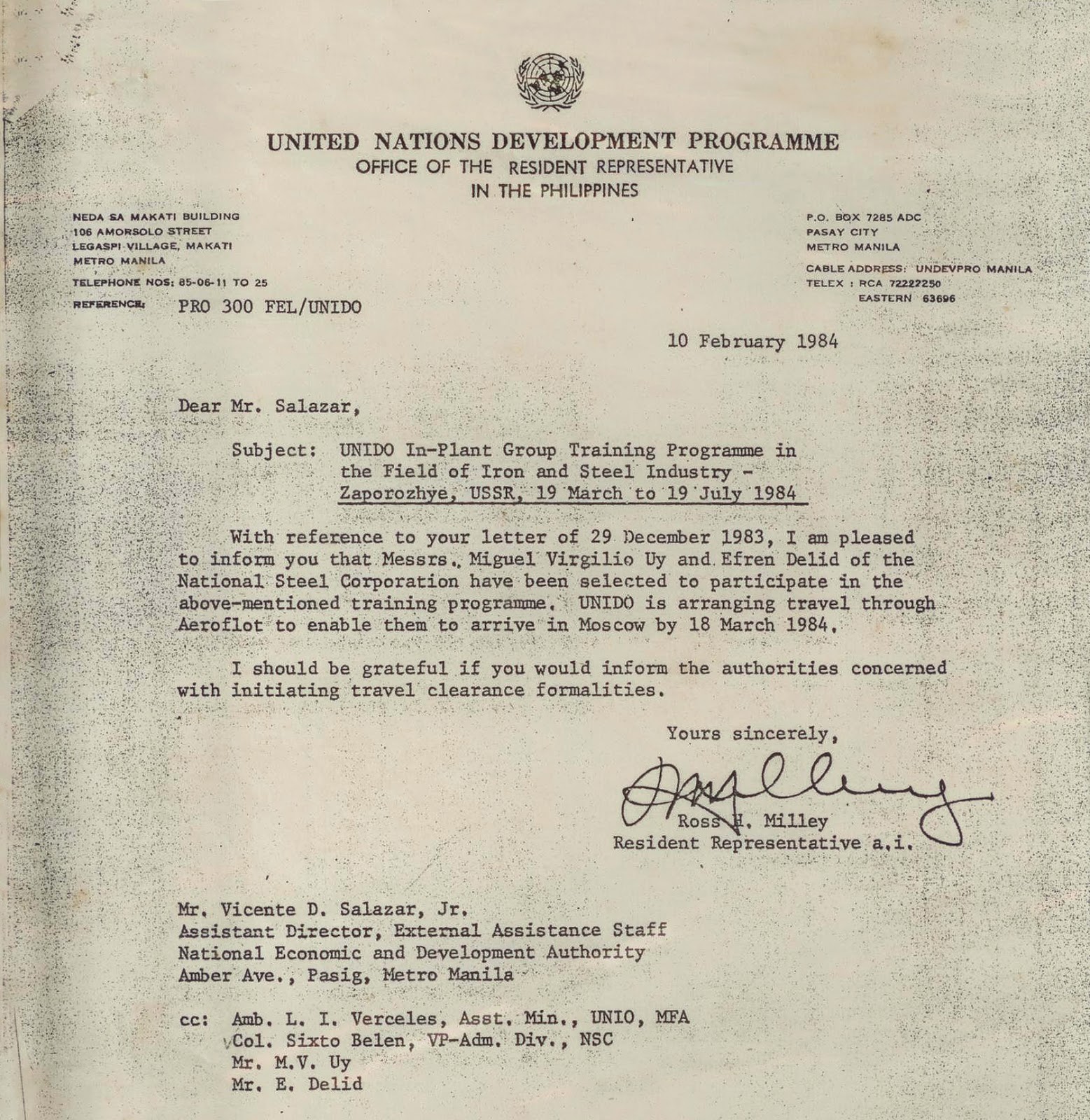
It all started 33 years ago today on April 21, 1976 when barely a month after my graduation in college with a degree in Chemical Engineering from University of San Agustin in Iloilo City, I, together with 25 other young engineering graduates from prestigious schools in Visayas and Mindanao were formally welcomed to National Steel Corporation in Iligan City. We were selected from among thousands of other engineering graduates who survived the tough written and panel interviews. We were officially called Industrial Engineers assigned to the Industrial Engineering Department, an elite think tank of the company doing standards, methods, and economic analysis in practically all aspects of the business and operations of the company.
Our batch was indeed "star-studded". We were all honor graduates, with a summa and a number of magna, and cum laudes. For the next 18 years, I would stay with the company. We were honed and exposed in managerial, technical, human resource, training and organizational development, marketing, corporate planning, and financial and economic aspects of steel business. Many of us were trained abroad sponsored by JICA, AOTA, UNIDO/UNDP and equipment suppliers, plus our own company sponsored trainings and seminars. I myself had the privilege to undergo a four-month training in Russia and a two-month training at Bethlehem Steel in Indiana, USA. During those years, we were not just witnesses to the company's rise and fall but we were in fact actively involved in all of these endeavors, from concept to implementation and maintenance. Those of us who stayed longer spent perhaps our best years in our professional lives.
In the next few years, National Steel Corporation would recruit more IE's (and later on EMT's or engineering management trainees). This was in preparation for a larger operation of an integrated steel plant. This was a dream, conceptualized in the early 1950's by our predecessors and dreamed about by those who came later, us included. Sadly, until now, this remained a dream. And for those of us who experienced those glorious years of expansion and activities, it is utter disappointment and frustration to see how the steel industry in the Philippines has gone on a backward direction when most of our neighbors have gone a tremendous leap towards integration and industrialization.
Many of us are now in foreign soils, US, Canada, Australia, New Zealand, the Middle East, Malaysia, Vietnam, etc. A number are still left in the country, many in the Metro Manila area. This dream is the bond that binds us of our past, present and perhaps optimistic that in our generation, that dream will still be realized. THE DREAM LIVES ON.
Our batch was indeed "star-studded". We were all honor graduates, with a summa and a number of magna, and cum laudes. For the next 18 years, I would stay with the company. We were honed and exposed in managerial, technical, human resource, training and organizational development, marketing, corporate planning, and financial and economic aspects of steel business. Many of us were trained abroad sponsored by JICA, AOTA, UNIDO/UNDP and equipment suppliers, plus our own company sponsored trainings and seminars. I myself had the privilege to undergo a four-month training in Russia and a two-month training at Bethlehem Steel in Indiana, USA. During those years, we were not just witnesses to the company's rise and fall but we were in fact actively involved in all of these endeavors, from concept to implementation and maintenance. Those of us who stayed longer spent perhaps our best years in our professional lives.
In the next few years, National Steel Corporation would recruit more IE's (and later on EMT's or engineering management trainees). This was in preparation for a larger operation of an integrated steel plant. This was a dream, conceptualized in the early 1950's by our predecessors and dreamed about by those who came later, us included. Sadly, until now, this remained a dream. And for those of us who experienced those glorious years of expansion and activities, it is utter disappointment and frustration to see how the steel industry in the Philippines has gone on a backward direction when most of our neighbors have gone a tremendous leap towards integration and industrialization.
Many of us are now in foreign soils, US, Canada, Australia, New Zealand, the Middle East, Malaysia, Vietnam, etc. A number are still left in the country, many in the Metro Manila area. This dream is the bond that binds us of our past, present and perhaps optimistic that in our generation, that dream will still be realized. THE DREAM LIVES ON.
Labels:
profession,
steel,
steel industry,
work
Sunday, April 19, 2009
Holy Week Memories of Russia
We returned to training class in Zaporozthahl Training Center the day after we arrived from that enjoyable and educational trip to Kiev. Though we've been away only for a short period, so many changes it seemed happened especially in our surroundings. The plants and the trees had grown again and the leaves appeared so full of life compared to those early days of our arrival when they looked dead and lifeless, covered with snow. It was a beautiful springtime and a Holy Thursday. But there is no holy week in Russia.
Before Lenin and the Bolsheviks came to power in 1917, Russia was a Christian orthodox country. Testaments to this were the beautiful and grandiose cathedrals with magnificent domes (often gold plated) and exotic architecture. The czars and their empresses were closely related by blood with the monarchs of central Europe and in those olden times, intermarriages between relatives in monarchies were common. Even at present time, it is not uncommon to see women with crucifix necklaces worn publicly, despite the ban on religion.
In our hotel, which is always frequented by tourists from East Germany, Poland, Czechoslovakia, Romania, etc. (the so called Communist bloc), I would often see elderly women wearing such necklaces. At one time at the elevator, just to show to these women that I am also a Catholic, I greeted them with the only words I know they would understand: "Viva El Papa John Paul." They were surprised yet fully delighted to return the same compliment.
Still feeling the Kiev hangover and to break the boredom of the training class, Mike and I found a reason not to attend the next day's class. Every Friday, our three Egyptian and one Pakistani classmates would excuse themselves from class before noon and return to our hotel for their Friday noon prayers facing the direction of Mecca. We always tease them about this but we understood and respected it. So we asked permission from our training director, Comrade Soroko, invoking our Catholic faith and religious practice.
So, on that Good Friday, April 20, when everybody in the city didn't seem to know about it, we rested and prayed in our hotel.
Note: Photos of the cathedrals are HERE.
Before Lenin and the Bolsheviks came to power in 1917, Russia was a Christian orthodox country. Testaments to this were the beautiful and grandiose cathedrals with magnificent domes (often gold plated) and exotic architecture. The czars and their empresses were closely related by blood with the monarchs of central Europe and in those olden times, intermarriages between relatives in monarchies were common. Even at present time, it is not uncommon to see women with crucifix necklaces worn publicly, despite the ban on religion.
In our hotel, which is always frequented by tourists from East Germany, Poland, Czechoslovakia, Romania, etc. (the so called Communist bloc), I would often see elderly women wearing such necklaces. At one time at the elevator, just to show to these women that I am also a Catholic, I greeted them with the only words I know they would understand: "Viva El Papa John Paul." They were surprised yet fully delighted to return the same compliment.
Still feeling the Kiev hangover and to break the boredom of the training class, Mike and I found a reason not to attend the next day's class. Every Friday, our three Egyptian and one Pakistani classmates would excuse themselves from class before noon and return to our hotel for their Friday noon prayers facing the direction of Mecca. We always tease them about this but we understood and respected it. So we asked permission from our training director, Comrade Soroko, invoking our Catholic faith and religious practice.
So, on that Good Friday, April 20, when everybody in the city didn't seem to know about it, we rested and prayed in our hotel.
Note: Photos of the cathedrals are HERE.
Tuesday, April 14, 2009
Kiev, April 15, 1984
Almost a month after we settled down in Zaporozhye, we arrived in Kiev on a beautiful spring morning of Palm Sunday, 25 years ago today, for a 4-day visit to this capital of Ukraine, then the 2nd most prosperous among the 15 republics of the USSR.
Having obviously lost contact with the outside world, I didn't even remember it was already Holy Week. Booked at Hotel Ukraine, our first impression of the city was good. It was clean, with more beautiful buildings and sloping, hilly streets, some of cobble stones
Kiev is an old city, and the 3rd largest city of the Soviet Union after Moscow and Leningrad. It is a city of parks (there were 150 of them all), monuments and memorials, just like any other city there. Places we visited were the Arc of Friendship (where Kiev was founded) overlooking the famous Dneiper River, Prince Andrew Cathedral, the Marinsky Palace of the Czar, War Memorial, Ukrainian Parliament, Chekovsky University, a 100,000 sports complex (home of the Kiev Dynamo Football Club), and the vast Exposition of the Industry of the Ukraine. There were no plant visits this time; it was a purely social and cultural trip, which we liked.
But we equally enjoyed our "on our own" adventures in the city, mingling with the people, drinking in bars and cafe's or just standing idly along the street pavements, enjoying the sites of people passing and couples kissing.
At dinner on our first night, we were delighted to hear for the first time, attendants greeting us "Dobre Becher" (Good Evening!). Service however was still the same. Slow.
Kiev was more urban, in fact quite Western in some ways, with more foreign tourists roaming , mostly though from the European Eastern Bloc nations.
It was an eventful visit. Events in later years would prove historic for this seat of Ukrainian power after the disintegration of the mighty Union of Soviet Socialist Republics.
Friday, March 27, 2009
The EU RoHS Compliance
A few weeks ago, a prospective customer conducted a supplier audit of our company; business process, raw material and finished products, quality control, procurement system, etc. This customer is into the manufacture of electrical equipment mainly exported to Europe, specifically Germany. Thus beside assessing our management systems (our company is certified to both ISO 9001 and ISO 14000 Quality and Environmental Management Systems), focus was also on our being "EU Compliant on RoHS Directive".
RoHS ( Restriction on Hazardous Substances) Directive 2002/95/EC of the European Parliament and European Council, published on February 13, 2003, restricts the use of certain hazardous substances in electrical and electronic equipment. It states that by July 1, 2006, products sold in the European Union member states must be made free of these substances.
These hazardous substances were identified as Lead (Pb), Cadmium (Cd), Mercury (Hg), Hexavalent Chromium (Cr +6), Brominated flame retardants Polybrominatedbiphenyl (PBB) and Polybrominateddiphenyl ether (PBDE).
The issue on lead actually made headlines sometime ago when it was discovered that the maker (in China) of a popular US toy brand were found to have beyond tolerable levels of lead. Just recently also, on primetime Phillippine news, thousands of slippers for children of a popular brand were cut to pieces and destroyed by government regulating agencies and thousands more were recalled from the market shelves because of the presence of lead used in the paint for the slippers.
RoHS ( Restriction on Hazardous Substances) Directive 2002/95/EC of the European Parliament and European Council, published on February 13, 2003, restricts the use of certain hazardous substances in electrical and electronic equipment. It states that by July 1, 2006, products sold in the European Union member states must be made free of these substances.
These hazardous substances were identified as Lead (Pb), Cadmium (Cd), Mercury (Hg), Hexavalent Chromium (Cr +6), Brominated flame retardants Polybrominatedbiphenyl (PBB) and Polybrominateddiphenyl ether (PBDE).
The issue on lead actually made headlines sometime ago when it was discovered that the maker (in China) of a popular US toy brand were found to have beyond tolerable levels of lead. Just recently also, on primetime Phillippine news, thousands of slippers for children of a popular brand were cut to pieces and destroyed by government regulating agencies and thousands more were recalled from the market shelves because of the presence of lead used in the paint for the slippers.
Subscribe to:
Posts (Atom)