Monday, April 21, 2014

My Russian Diary - Odessa at the Black Sea

Odessa @ the Black Sea - June 24-29, 1984

Odessa, the port city at the Black Sea was our last out-of-town trip. In a few weeks, our 4-month training will end and Odessa seemed the perfect place for culmination. It was late June and summer made people go out and relish the sun after months of cold and snow. As expected, Odessa’s beaches were swarmed with people.


Back then, I haven’t known nor heard about Odessa. I have heard about the Black Sea and had even wondered why it was called “Black”. But I haven’t known its strategic geographical relevance to Russia (or the Soviet Union then) and to Europe and the Middle East. But our almost a week visit to this city, declared by the Soviet government as a “hero city” in recognition of its role during The Great Patriotic War ( as they called World War II), made a lasting impression  of how beautiful  the city was. Rich in history and culture, it was USSR’s important   gateway to the Western World via the Indian Ocean and the Mediterranean.  This I further confirmed when two of our Egyptian co-trainees opted to travel home by ship from Odessa instead of joining us to Moscow and connect to Cairo.


Perhaps  the  most memorable experience I had was when we watched a ballet show at the famed Odessa Ballet and Opera House. Russia was and perhaps still is tops in ballet and their Ballet and Opera Houses were just magnificent. We were seated at the exclusive balcony section at the side near the stage, a good full view of the whole opera house with those magnificent chandeliers hanging over. It was my first and so far the only time I have ever watched a ballet show performed by world renowned ballet dancers.  Weeks  later, in Moscow, while in transit waiting for our flight back home, we visited the ultimate ballet house, the Bolshoi Theatre, but unfortunately we were not able to watch a show. It was then closed for maintenance.

Another memorable experience we had was our attempt to dip and bathe in the Black Sea. The sun has been up for weeks, and daily, multitudes of people of all ages and shapes, swarmed the beaches, enjoying summer. But as we jumped to the waters, suddenly we froze. The Black Sea waters  was still freezing cold- to us. That abruptly ended our swimming adventure at the famous Black Sea.

One night too, while listening to a Russian band and drinking our usual Vodka, Cudra, our colleague from Mozambique, told me he thought he saw “your Philippine countryman “ at the lobby. I disagreed and told him “there are no Filipinos here for what will he be doing here in this faraway land?”. For almost 4 months, we haven’t had encountered any Filipino nor had we heard any news about our country. A little while later, I went to the comfort room. And just as I was fixing my hair in front of a mirror, 2 guys of my size and color came in. They didn’t look at me but instead passed by where I stood and in a voice loud enough for me to hear, uttered the sweetest word I haven’t heard in a long while- KABAYAN. It was their way of testing whether a stranger is a Filipino or not. How happy and glad I was to meet them; one was from Ozamis and the other from Cebu. They were Filipino seamen and their ship was docked at Odessa port to unload and backload cargos. Later, when I returned to the bar, I told my Mozambique friend about it. His reply: I told you so!    

Sunday, April 20, 2014

My Russian Diary - Day 27

Day 27 – April 15, Sunday, Kiev

The Aeroflot plane was small with 28  passengers only and no check-in baggage. Arrived in Kiev in one hour. First impression of the city was good. Clean, inclined streets, more beautiful buildings. Checked in at Hotel Ukraine. From the outside, it looks simple but inside, it was magnificent. After check-in and breakfast, off we go for sight-seeing. This is the first order of the day in all our travels in different places.


Kiev, the old and third largest city of Soviet Union is like San Francisco, hilly. It is the capital of Ukraine, second largest and most prosperous of the 15 republics. It has many parks, 150 in all and many memorials and monuments. Soviet cities are known for this. I guess this makes up for lack of entertainment places. Many streets were made of cobble stones. Visited the Arc of Friendship, site where Kiev was founded. Panoramic view overlooking the famous Dneiper River. Visited Prince Andrew Cathedral, a 100,000 capacity sports complex, the grave of the unknown soldier, Czar’s Palace, Ukrainian Parliament, Chekovsky University, etc. Afternoon, we were at the Exposition of Industry in Ukraine – a 300 hectare pavilion telling the story of the place. Soviets are particular of this. They have a very rich and ancient culture and they really preserved it.


My Russian Diary - Day 3

Day 4 - March 23, Zaporozhye

Woke up at 6:30. Medical check-up is at 8. Not feeling well. Vodka and champagne last night. Outside, I could see only  few people on the streets.

At 8, people started to go out. Realized  that drivers of buses and trolley cars were women. Quite amusing. And hotel utility people were also women, mostly of late age and fat. But they were nice, cheerful and honest people. We call them our dear “babushkas”.

A funny thing happened during my check-up. Just when the lady doctor placed her stethoscope on my breast, my Citizen Ana-Digi watch chimed. Both the doctor and Lyudmilla, our interpreter, were stunned, the stethoscope falling out of the doctor’s hand. This technology has not yet come to their place. They could only laugh at their ignorance.


Went back to the hotel at 4 pm. Café and restaurant were closed. Had to go out with Cudra ( from Mozambique) to take some food. Found few eating places but many people were falling in line. This is a common thing here, queuing in cafes, open markets, shops, everywhere. Every morning at the hotel, we fall in line for breakfast. And the pace was so slow. Finally, found one place but there was nothing to choose. Service and quality are visibly absent here.

That night, Mumtaz (from Pakistan) brought us to a party inside the hotel in celebration of Pakistan Day. Many Pakistanis came, mostly exchange students  and  worker trainees. Champagne and vodka flowed and we drunk a lot. My Philip Morris and Marlboro were favourites. Russian cigarettes were lousy. And people danced with gusto. And how they love foreign music. Old Western favourites-Yesterday, Feelings, Ebony and Ivory were hits. Just before midnight, the party broke up. All activities here stop at midnight.  Amused at everybody hurrying down the streets while militiamen scour the area, seeing everything’s in order and everybody leaves the place. Even drunk people follow to the letter this regulation, without question. And to think that their militiamen carry no guns-only radio and ‘’batuta’’. But I observed them to be strict but disciplined too, and respectful. Call that fear or respect of the law, but to my mind this is so far the safest place I’ve been to and known.

Finished the night with more Vodka at Muminagic’s ( from Yugoslavia) room.

Thursday, April 17, 2014

My Russian Diary - Day 2


Day 2 - March 21

It was already 7:00 AM and the city seems still quiet. Below, only a few people can be seen walking on the streets.  Eleazar, my classmate from Peru, told me last night that only few people are seen outside because most of them pass the subways—the Metro, they call it, those marvelous underground structures used as shelter during the last world war.

It seems to me Moscow is peaceful, not hectic like Manila. I saw only a  few cars  and  traffic was nowhere to be seen, although from time to time, cars have also to stop at street lights. Quite orderly. Buildings were more of less of the same design. Like boxes, especially the apartment houses.

It was still snowing when we came down the hotel. Oleg fetched us for our flight to Zaporozhye. There were no porters at the airport nor at the hotel. We were  left on our own to carry our luggage. How my shoulders ached. Surprised that there were only four of us in the pre-departure area. Later we learned that foreigners have separate terminal areas. Upon boarding, we were again whisked to the ramp separately. The Russian passengers boarded only when we were already settled on our seats. And there were no seat numbers.

Then Zaporozhye--our home city for the next four months, a major industrial city of the Ukraine region. We stopped in the middle of a big airport, doubling as an air base. At the far other side are hangars of the MIG fighter planes. Temperature was -10 degrees C and first time I stepped on melting ice; I had no hat nor gloves. The winter wind was terrible. I couldn’t understand why the baggage claim area was outside the terminal.


Settled at the 10th and last floor of Hotel Zaporozhye (In Tourist Hotel) - the best in the center of the city. Vladimir Soroko, our training director came up to welcome us. Went down at 9PM  with Jorge and Eleazar. The basement bar was full and noisy and there were many beautiful girls. Didn’t know what to drink. Finally, I decided to go back to my room and rest. Still a long way to enjoy.

My Russian Diary - Day 1

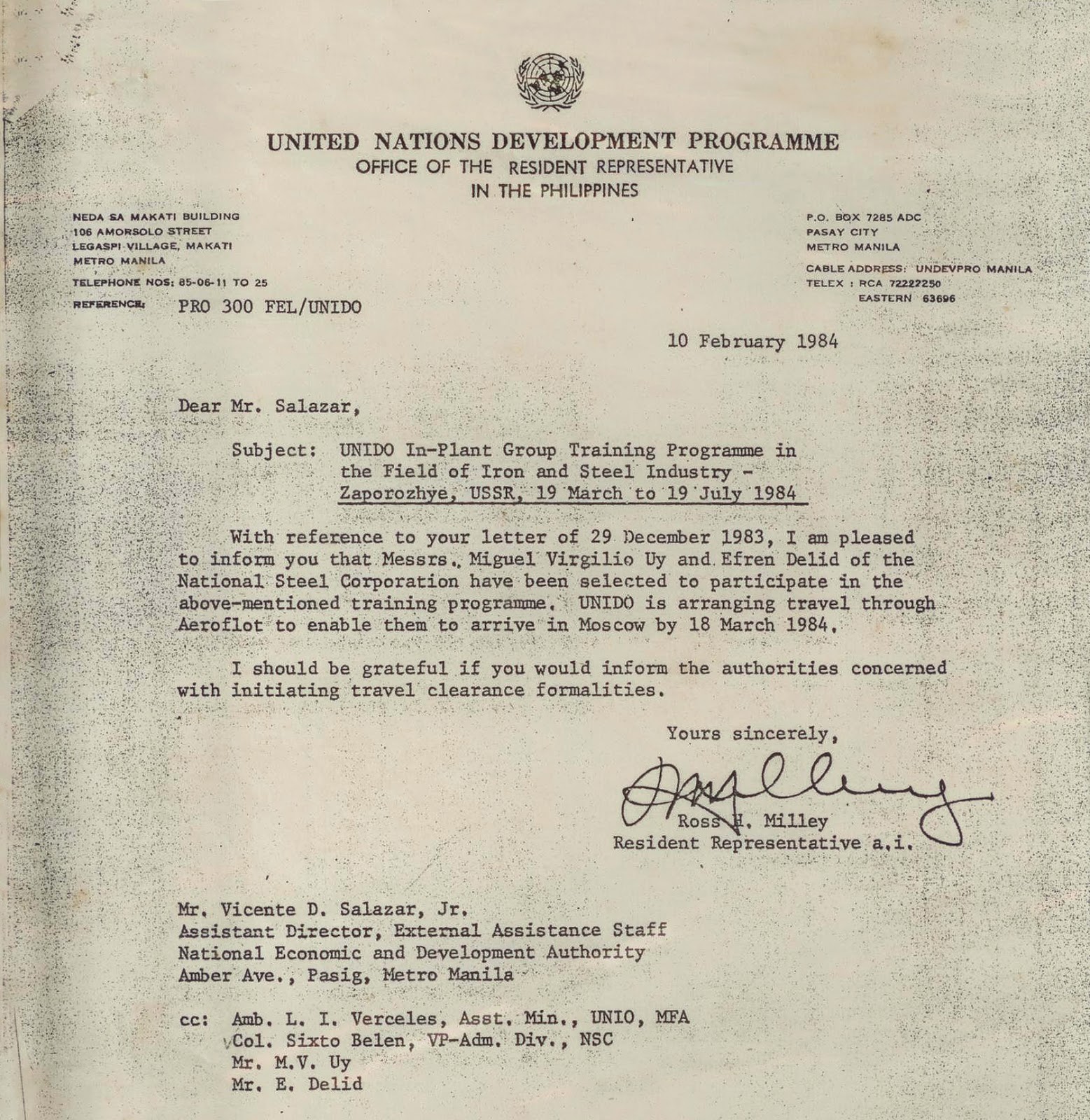
Thirty years ago at about this time, I arrived in Moscow for a 4-month technical training in steel. It was  then called the Union Of Soviet Socialist Republic (USSR), which I later learned was composed of 15 republics. It was also named  Soviet Union. That period was Chernenko’s era, who took over after the death of  long time leader Brezhnev. A few years later, Gorbachev took charge, introduced  “glasnost” and “perestroika” and the rest was history.

I was then a Senior  Supervisor at Quality Assurance  Dept. Of National Steel Corporation in Iligan City  and together with Mike Uy, also a Senior Supervisor at Hot Mill Operations, we represented the Philippines in  the 27th UNIDO/UNDP  In
- Plant Training  for Iron and Steel Engineers from March 19 to July 19, 1984 at Zaporozhstal Iron and Steel Works in Zaporozhye, Ukraine. While based in Ukraine, our group of 17 engineers from 10 developing countries travelled far and wide the former Soviet territories, by bus, by train, by plane. From the capital Kiev, Krivoi Rog, Zdhanov, Donetsk, Boronets, in the heartland of Ukraine to the western port city of Odessa in the Black Sea, to the Russian region of Liepetsk, Cherepovets, Leningrad in the north and the capital Moscow, we saw its  vastness and  the richness in resources, culture, and history. Most of all, we saw and learned who they are, how different they were, and how they lived in that time.

I first published excerpts of my dairy in the NSC News, the official magazine of National Steel Corporation in 1989, the year Soviet Union was disintegrated into independent states. The recent incidents of conflicts which started last year in Kiev and spilled over to the Crimea region in the Black Sea and now the crisis in the border areas like Donetsk,once again brought back vivid memories of my memorable stay in that wonderful faraway place.


Day 1- March 20, Moscow

“Ladies and Gentlemen, in just a short while, we are landing at the Shereyetmevo International Airport. Time is now exactly 7 in the morning. Ground temperature is 14 degrees below zero”, came the Aeroflot’s stewardess’ final announcement. Suddenly, almost everybody stood up and reached for their overcoats, hats, and gloves. I remained seated, glued to the window. Below, everything was white. I could see Russian airport personnel standing dutifully on guard, in thick fur hats and overcoats, the read insignia blazingly visible from above. Beautiful-just like in the movies.


It was a bitter winter initiation for me. All along the drive from the airport to my hotel, the Rossia Hotel, reportedly Europe’s largest with 3,000 rooms, strategically just a stone’s throw away from the Kremlin Red Square, I have to raise both my feet to fight of the cold seemingly penetrating through my bones. I should have known better, I thought. Napoleon and Hitler learned this the hard way, and with it shattered their dreams of world conquest.’’Mr. Oleg (my guide/interpreter) but I thought it’s already spring time’’, I protested. “Mr. Delid, to the Ukrainians, it’s still winter time. To the Muscovites, it’s now spring time.’’ My first lesson here: for me, they’re just one and the same—Russians.


I slept practically all day. I left Manila the day before with stopovers in Singapore and New Delhi and the long journey took its toll. And for the first time, I learned that Manila time was 5 hours in advance.  The cold weather all the more made it conducive to sleeping. Later, had dinner of chicken and bread with my two Peruvian classmates in one of the hotel’s many restaurants overlooking Red Square. Against the backdrop of the magnificent Kremlin and Lenin Mausoleum dutifully manned by the Red Guards, we toasted for our safe arrival and for the good things to come.


Tuesday, July 9, 2013

The Phinma Group formally launched its Business Continuity Management (BCM) Program

The Phinma Group formally launched its Business Continuity Management (BCM) Program in a Kick Off Forum and Training held last June 20, 2013 at Microtel Mall of Asia, Pasay City.

As stated in the BCM Policy Statement, which was signed by Mr. Ramon R. Del Rosario, Jr., President and CEO of Phinma, Inc., and Mr. Roberto M. Laviña, Senior Executive Vice President and COO of Phinma, Inc., Phinma “aims to ensure  that all its companies are able to achieve their respective strategic business objectives by safeguarding its processes and operations with business continuity management plans.”

Highlight of the activity was the signing of the Phinma Business Continuity Management Pledge led by Mr. Oscar J. Hilado, Chairman of Phinma, Mr. Ramon del Rosario, Jr., Mr. Roberto M. Laviña, Mr. Victor J. Del Rosario, Phinma Chief Strategy Officer and UGC Vice Chairman and CEO, and other executives from Phinma’s Business Units.

UGC was represented by SVP Pines Roranes, VP - Manufacturing Romy Salanga, AVP -Comptroller German Costales, AVP - Rollforming & Distribution Manny Alvior and AVP - Customer and Technical Services Nono Delid. Together with 6 other executives from Phinma’s other ‘business units, they also signed the BCM Pledge and attended the one day orientation training/seminar conducted by SGV and Co. (Ernst and Young).

In the UGC BCM organisational set-up President Art Florendo will be the BCM Champion, German Costales as BCM Coordinator and Pines Roranes, Romy Salanga, Manny Alvior and Nono Delid as Process Owners. They will form the core group of UGC in this program.


Tuesday, June 11, 2013

“Quality and Safety Are Not The Same Thing!”


That’s according to Mr. Jon Echanova, EU Key Expert-National Quality Infrastructure during a forum with PPSQF (Phil. Productivity, Safety, and Quality Foundation) held last month at Citibank Tower in Makati. It was the same subject he echoed in other fora for government agencies especially DTI and other business organizations.

The forum was about the National Quality Infrastructure (NQF) which they want to establish in the Philippines under the EU-Philippines Trade Related Technical Assistance Project 3. According to Jon, trade is the driver for growth and the basic question now is how we can make the best out of something that is bound to happen- market globalization. This project therefore hopefully will prepare the Philippines for the global market and ASEAN harmonization scheduled to start in 2015.

He is proposing the creation of a  National Standards Board, which our current Bureau of Product Standards (BPS) is not. He emphasized that “Standard Bodies” are different from “Regulatory Bodies”. Our BPS is doing this in a dual role. He added that safety standards should be separated from quality standards. Our existing national standards in contrast do not separate safety from quality standards. In fact, more often, safety defines quality. Further clarifying, he said standards are voluntary whose purpose is for common understanding and are prepared by standard bodies. On the other hand, technical regulations are compulsory whose purpose is for protection of health of health, safety, and environment and are prepared by regulatory standards. Sounds interesting.

Ironically, in our present Philippine National Standards (PNS), products that have “impact on safety, security and health” are considered as “mandatory” and a PS (Philippine Standard) license is required before manufacturers (for importers, Import commodity Clearance or ICC is required) can distribute and sell in the market. Quality and safety are just one and the same.

I have been a member of the BPS Technical Committee on Flat Steel Products (TC 64) for more than 10 years now as “industry expert’. Our committee’s function is to review and formulate product standards on flat steel products which include, among others, hot-rolled steel, cold-rolled steel, and galvanized steel. This is the industry where my whole professional life has been centered.


I find this subject therefore very interesting. But knowing the “realities”, out there, I’m afraid this may just end up as a wishful thinking. 

Wednesday, May 22, 2013

The State of the Philippine Steel Industry: An initial Look Today


Two Wednesdays ago, I attended the regular board meeting of the Philippine Iron and Steel Institute (PISI) in lieu of our president who was then out of town. Our president has been a long time officer of the board representing the Flat Steel Sector and in times that he is not available, he would send our vice president for manufacturing, or me to pitch in for him in such meetings or in other PISI activities, forums, etc. That  help us get first hand updates of what’s going on in our world of steel from steel gurus and businessmen.

The PISI is an umbrella organization of all steel stakeholders, namely, suppliers, traders/importers, manufacturers, etc. Its membership cuts across various steel industry associations and individual companies. Its objective is to promote, enhance, and protect the interest of its members as well as the steel industry as a whole. Incidentally, the current president, was my close colleague during our years at National Steel Corporation in Iligan City.

A hot topic discussed (which is actually a regular item in all meetings) is the hottest subject which hogged the headlines recently- smuggling. For many years, smuggling or technical smuggling specifically, has always been identified as the menace in the industry. In recent years, it has become rampant to alarming levels. Like other business sectors such as oil, agri- products ( like meat, poultry, and rice), etc.,  the Institute had been expressing outcry and consistently decried the unabated rampant smuggling, most common of which are under declaration or misdeclaration. For 2012 alone, estimated loss due to smuggling reached P1 billion. It has been common that people are already immune to it  and that any news about it is not news anymore. When will that day come when we all can say,” it’s time to play hardball”.

Another main feature of the meeting is the report on imported steel price. From scrap to billets, slabs, hot-rolled and cold rolled coils, plates, tin plates, GI, PPGI, figures from traditional sources namely, China, Taiwan, Japan, Russia, it was reported that  last month’s prices generally went down compared to the previous month. April prices for  (figures are in US dollars per MT) scrap bulk sea cargo was at 375, containerized ex Taiwan at 395, HRC ex Taiwan was 580 and ex China is 560, 0.6mm CRC at 600 and 0.17mm CRC iwa at 700, 0.33m GI at 840 and PPGI at 950. Interestingly, while prices are going down and analysts say demand will be depressed, China increased its steel output by 9.1% this first quarter, year on year. For Jan-March 2013 alone, total China output is now pegged at 192 Million MT.

Next month, SEASI or Southeast East Asia Steel Institute will hold its annual international conference. Every country member presents their respective country report. During the board meeting, a tentative PISI country report was presented for comments, validation, etc. I noted some highlights; first on the  GDP  report where, from the 6.6% GDP growth registered in 2012, in the Industrial sector, it was Construction which registered the highest growth of 14.4% while Manufacturing stood at only 5.4%. In the Services sector, transport was highest at 9.1%. Another notable highlight was in our GI/PPGI/Aluzinc/EGI sector. For 2012, total 2012 importation reached over 530,000MT, around 35%   increase from the previous year level indicated by the updated data from the Bureau of Imports (BIS). This is because, most, if not all galvanizing plants are not anymore producing or are not anymore operating and merely imports these coated products mostly from China. The reason is pure business economics. It is now cheaper to buy imported GI products than buy CRC raw materials  and process or convert them to GI. Sadly,manufacturing of galvanized steel is one sector which has not only declined but is tilting on the verge of extinction.

Friday, May 10, 2013

The Journey Continues: Tale of Steel Companies, Part 2


Fast forward. Four months from now, my 2nd and current company, Union Galvasteel Corporation (UGC) will celebrate in style its 50th year of existence. Center of celebration will be at the place where it all started in 1963, at Poro Plant at Poro Point in San Fernando City, La Union. As the company celebrates its golden years, it is likewise excitedly looking ahead for the next 50 years and perhaps beyond.

Fifty years ago, the company, then named Bacnotan Steel Corporation (BSC), a division of Bacnotan Cement Industries, started with its old, sheet to sheet galvanizing operation producing GI sheets for roofing products. Five years later, another similar type of galvanizing operations was opened in Davao City. It was only in 1990 when it opened up in Calamba City, Laguna which would then become until now as its main plant. It started to expand and modernize with the construction of its coil by coil color coating line in 1993 and the commissioning of its continuous galvanizing line in 1997. The Asian financial crisis took its toll and nearly brought down the company to bankruptcy. But with a bamboo like tenacity and resiliency, brought about by overall restructuring of its operations and strategies, it survived the storm and started to expand more, both in reach and products lines. Today, it has the country’s biggest supply chain and distribution network in the industry with 26 roll forming plants, warehouses, and sales offices strategically located throughout the country from north to south. “Sa Tibay at Ganda, Panalo Ka” has become an institutionalized tagline of the company.

I joined UGC in the latter part of 1996 at the worst time when the financial crisis was hitting the company, the industry and the country real hard. All through these years, I did my fair share, practically in all aspects of the business, from operations, technical/quality assurance, marketing, human resource, training, finance, etc. Externally, I have broadened my scope of knowledge and understanding of the industry, not just locally but regionally as well, through active involvement and regular liaisons with steel industry associations and leaders, government agencies, customers, competition, suppliers, environmental groups, consumer advocates, etc. I even wrote a technical paper about how the company survived the crisis, which I presented at the SEASI International Conference in Kuala Lumpur, Malaysia in November 2002. Indeed, an enriching experience.

Emma A., a dear colleague from NSC who is now happily settled in Canada, once asked us to write about our life after steel. This is what I wrote; “Fortunately or unfortunately, my life is STILL WITH STEEL.

It seems like I have taken my steel career in full circle. But not quite.

Wednesday, May 8, 2013

The Journey Continues: Tale of Steel Companies, Part 1

Two significant events will happen in the next few months to the only two companies that I have been connected (read: employed) throughout my professional career. These events definitely define my “steel journey.”


Eight months from now, the moribund National Steel Corporation (NSC), then the largest steel company in the Philippines, would have been 40 years. It was established as a forerunner of the National Shipyard Corporation in the 1950’s and later on the IISMI or Iligan Integrated Steel Mill Inc. in the 60’s. All the main plants were located in Iligan City in northern Mindanao. Active and loyal “alumni” based in Manila are organizing a grand reunion on its anniversary month, February next year for all its ex-employees from Iligan Plant, Pasig Plant and Makati-Home Office many of whom are already settled abroad. This will surely be big event to enjoy and reconnect. There will be lots of hugs and kisses and embraces and lots of reminiscing, something which will make everybody’s hearts sink. Once upon a past era, these were the “steel trailblazers” who aspired and dreamed of “building the Country”.

I joined NSC as an engineering management trainee (we were then called Industrial Engineers) barely a month after college graduation. I am proud I belonged to this group, which former president Rolly Narciso described in his tribute as “among the best technical and managerial mind of NSC”. When I left 18 years later, already a developed professional, the NSC ship was already sinking and it was only a matter before this steel giant finally closed down 5years later. In that span, many left the company and the city for good. Notably, many migrated abroad to Canada, the U.S, Australia, New Zealand. the Middle East countries and the neighboring ASEAN countries. Such exodus can be aptly described as “the great brain drain”. Still, quite a number, including me, moved to the big city, Manila while some remained and cast their luck with the lamentable Malaysian and later on Indian owners who likewise closed shop without even taking off, weighed down by lack of capital, technological obsolescence, loss of market and overall mismanagement. What happened to the Iligan plant, its once thriving employees’ community called “Steeltown” and perhaps the lives of its people is reflected in the movie and now Broadway and Manila musical, Full Monty.

What a sad ending to a glorious past!

Sunday, September 2, 2012

Steel Connecting in China Part 2

At the Green Resort Restaurant, Ningbo, China


Aug. 08, 2012
The day before, we flew to Ningbo City but our flight returned to Xiamen due to typhoon Haiku ( I think this was typhoon Gener coming from the Philippines). While Manila and northern Luzon was battered by continuous rains and flooding, China's central eastern parts were likewise smarting from floods and strong winds.

We spent the morning waiting for confirmation of the flight and later decided to go to downtown Xiamen. We took lunch at Robinson’s Mall, Xiamen. Together with SM, I felt some measure of pride that such purely Philippine mall brands are conquering China. We know of course that they are owned by the family of Henry Sy and John Gokongwei who, like most Chinese Filipino taipans, they originally came from this place, Fujian or Amoy as we used to know. It was hot outside but my hosts told me we have to cool down over a bottle of beer. Shortly after we returned to the hotel, the airline bus picked us up. Our flight was confirmed to leave and we are finally flying out.


At Ningbo Sino Coalition Industrial Company Ltd

It was still wet and windy when we landed at Ningbo international Airport. It seemed like we were the only passengers at the airport. It was early evening, 6pm. but the place was already dark. There were still some flood waters at both sides of the streets. The expressway was lonely and dark. Save for one or two trucks and a couple of cars, the highway was all ours.

The airport to the hotel took us 45 minutes. Downtown Ningbo, I was told, was still 30 min. away. Some streets were still flooded and cars have to find shallow areas to pass through. The hotel was a star hotel, rated a "Green Hotel" but there were no other guests in the lobby and some services were not available because of the typhoon. We took dinner outside and later ventured to the streets. We still felt the strong winds battering the tress, the place looked desolate. Few cars were out on the streets, establishments were closed, buildings were dark, and there were no people roaming around. I didn't mind the "cold reception". I looked forward to the next day. I learned that the typhoon had already passed earlier in the morning .

At Zhejiang Southeast Metal Sheet Co. Ltd., Hangzhou, China


Aug. 09, 2012
We woke up to a sunny morning. Now the people were out on the streets. We learned some employees of te plant we visited were starnded in tier houses the day before due to floods.

After the meeting and tour, we were treated to lunch at a “Green Resort Restaurant”. It seems China is serious with their green campaign. Our hotel was rated as “Green Hotel”. It was indeed a hearty lunch of vegetable, fish, and meat and the typical "kampai" of beer.

After lunch, we drove to our final itinerary, Hangzhou. Running mostly at 140 kph. in a busy expressway of cars and trucks), it took us only 2 hours to reach our destination. Ningbo and Hangzhou are two major cities, and as expected, trade and business is flourishing.

Hangzhou is a tourist city. Their top tourist attraction, Western Lake, is considered as one of Chinese jewels. Hangzhou is bigger than Xiamen and just around 2 hours. car ride to Shanghai. I learned it is the favorite city of many Chinese  “rich and famous”. I was told that here, Ferraris, Lamborghinis, and other top luxurious cars are a common sight.

Many construction and expansion activities were visibly going on. In the areas in the vicinity of the plant, new communities are being built, new industrial zones are underway. The developments are fast that every quarter, when my host from Taiwan comes and visits the place every quarter, new structures come into place.

From the plant, our hotel, the luxurious 5 star Jinma Hotel, was 40 min. away. Downtown Hangzhou was  another 30 min. away. We just didn't have the time to explore and experience the beauty of the city. 


Aug. 10, 2012
We took the 7:40 a.m. one hour return flight back to Xiamen. Domestic terminal was fully packed with people. There were just so many Chinese locals travelling to and fro. Airport security was, or had been,  strict but firm and consistent. Everyone goes on a personal body search, front and back. Baggages are opened for unknown objects. They simply don't take chances as far as security is concerned. But I must say that they are efficient.

My flight to Manila was in the late afternoon so I still had enough time to go back to Robinson's mall to buy some pasalubong. After a lunch of noodles, David, my Xiamen host took me back to the airport. I spent the whole afternoon waiting for my afternoon flight.

We finally took off past 6, almost an hour delayed. This PAL flight was full; 90% were Chinese visitors. Upon landing at NAIA Terminal 3, we again spent 40 min. inside the plane. When we disembarked, we were surprised to learn we were not going through the tube, but had to take the stairway and the bus. At the customs area, there was another long wait we had to endure as all baggages of Xiamen Chinese passengers were opened. Finally, after going out, the last long wait was for the taxi. It was already past 10 pm. There was a long line of passengers but there were no taxis. This is already the 2nd time  that has happened to me. The first was in May with my family coming in from Cebu. The airport authorities just don't care whether there are transport available for late evening arrivals at Terminal 3. If you are the passenger, tired and weary or if you are the tourist, excited to visit Manila, that would not be fun at all.

After a long day, I arrived home past 11 p.m. It was however, still a fruitful, educational and productive trip.

Tuesday, August 28, 2012

Steel Connecting in China, Part 1


My steel journey continues.......

My recent trip to China last August 6 – 10  took me  to four (4) major cities and three (3) provinces from Southern to Central Eastern regions of Mainland China. With Xiamen in the Fujian province as my starting take-off point, I visited the following  (1) Guangdong Hanjiang Steel Plate Co. Ltd. located in Chaozhou City, Guangdong province south of Xiamen, (2) Sino Coalition Ningbo Steel Production Co. Ltd. in Ningbo City and (3) Zhejiang Southeast Metalsheet Co. Ltd. in Hangzhou City, both in the central eastern area of Zhejiang province, not far from Shanghai.

 The objective of my trip was to conduct technical meetings and evaluate the potential of these three (3) companies as suppliers of G.I. products in terms of their technical capabilities to meet specifications.

      This is my 3rd visit to China. The first 2 visits though took me only to Xiamen. And everytime I set foot in this beautiful city, I'm always met with something new about the place.

 When we first visited Xiamen in 6 years ago, in September 2006, construction was in frenzy; both within and outside the city. Steel demand was at its peak as China was preparing for the 2008 Beijing Olympics. There was only one SM Mall then, the first SM venture in China. When I came back last year, everything seemed in place. Buildings were completed and those construction outside the city were now converted to vibrant communities. There were now 2 SM malls. The first Robinson's Galleria was also completed with another one under construction. There was one notable sight though that did not escape me; the city became more green with full grown tress even in downtown Xiamen.

Taken from my hotel window, Swan Hotel


Aug. 06, 2012

I arrived Xiamen by PAL direct from Manila (2hrs. and 20 min.) at a little past 10 in the morning and was met by our Chinese traders who arranged my trip.. We drove directly to Guangdong Hanjiang Steel Plate Co. Ltd. It was raining all week in Manila when I left and so sunny Xiamen was a welcome relief.

It was a 3 ½ hour ride (30 min. for lunch stop over in a roadside rest and eating area) of long stretches of expressway, passing by three tunnels (cut from mountains) as long as 2 kms., bridges and viaducts up to 8 kms. long. It was indeed a rural setting and  only a few cars and trucks joined us in our trip. This is a glimpse of how China built its transportation infrastructure, interchange linkup on all communities to the highway. Road signs are everywhere in Chinese and English, just like in the US interstates, directional signs, safety signs, distances, speed limits per lane, etc. I could only wish those managing our expressways back home could at least learn some basic lessons on road management. This is the least we, or I who takes the South Luzon expressway everyday, could ask. After all, we pay high toll rates.

We finally reached our destination at around 2:30pm. That 3 hour actual travel time running at the average speed of 120 kph (reaching 140 kph), the distance we covered  must be around 350 kms, almost a back and forth distance from Calamba to La Union.

We spent around 2 hours in the plant covering our technical meeting and brief plant tour. Immediately after that , we drove back to Xiamen, arriving there at around 7:30 p.m. We checked in at Swan Hotel, a spanky hotel with a scenic view  along a river and a lake. At a private dinner later in the hotel, we were joined by a major principal of the trading firm. He is a Taiwanese businessman who used to work in major steel companies in Taiwan, BHP and Ton Yi.  We talked on developments in the steel industry, local and international and he went on retracing his days at BHP and Ton Yi. Quite proficient in english, he has now shifted to agriculture and put up a “mushroom” plantation and processing plant which
he hopes to export soon. “Mushroom he says is better than steel”.

Talking about the Taiwan connection, many companies, big and small in Xiamen and Fujian province for that matter, are owned by Taiwanese businessmen. Taiwan food products are also sold in many grocery stores. In the past, there were no direct flights from Taiwan to mainland China.  Taiwanese who visit Mainland China have to make make a transient stopover in Hongkong before proceeding to Mainland. Now, there are many direct  flights from Kaoshioung  to Xiamen, Hangzhou, and I suppose Shanghai and Beijing too.


Xiamen is beautiful at night. Bright, dancing lights in various colors, the place was vibrant  with many people going out to dine, wine and be entertained. The luxurious cars plying around, BMW, Mercedes, European, Japanese and American cars,  could attest the affluence of the city. Traffic is moving, despite the many cars.


During the day, you could sense the freshness of the city. It is clean and  green with trees and plants everywhere at the center and  at the side parking streets. There is practically no open space in the city as open spaces are planted with plants and trees. That is also true even outside the city. The long expressways were filled with trees and plants not only on both sides but also at the center separating both directions of the highway. No wonder, it is considered as the most livable city in China.

Saturday, September 10, 2011

Remembering World Trade Center, now Ground Zero, 25 years ago


It was 25 years ago that I visited this site; Ground Zero they now call. That time, it was the exact opposite of being ground zero. It was then an imposing twin tower skyscraper, symbol of America's might and reach. Inside the buildings was a picture of life, with all the hustle and bustle of corporate America. It was after all the World trade Center. Atop was a wide vista and horizon catching anybody in awe.


I came to America early March 1986, exactly one week after the historic EDSA People Power 1. The euphoria of this bloodless coup has reached the U.S. that everywhere we go, we seemed to be openly welcomed and looked up to. They were then hungry for our first hand report we brought from Manila. We were a group of 13 engineers sent by our company, National Steel Corporation, to the U.S. for a 2-month training on the operation and process control of the Blaw-Knox 5stand Cold Rolling Mill we bought from Bethlehem Steel Corporation. The venue was at Bethlehem's plant in Burns Harbor, Indiana.

Towards the end of our training, I made a whirlwind weekend rendezvous with my cousins based in New Jersey. Then came the tour of New York, one of the highlights of my stay in the U.S.


We had a boat cruise (was it Hudson River?), passing by another landmark, the Statue of Liberty at Staten Island while Manhattan and New York's skyline looming all along our cruise. We queued at Chinatown for a lunch of delectable steamed bass and adobong kangkong, strolled along 5th Avenue and St.Patrick Cathedral, relaxing at the Rockefeller Center and finally the must see must go places in New York, the Empire State Tower and the World Trade Center Twin Tower.


Lining up at the entrance was a thrill already, the same feeling I felt the first time I reached a skyscraper weeks ago in Chicago, the Sears Tower. The brief orientation further excited me and the ride in the express elevator to to top ( imagine reaching the first stop at the 90+ floor in 70 minutes) was an adventure. And finally, the view from the top. It was just exhilarating.


So how could I imagine the towers toppled, crushed to the ground by such treacherous terrorist attack of Al-Queda. There was no Al-Queda then. that time, Osama bin Laden was just a mujaheedin in Afghanistan fighting the Russian invaders and of all ironies, a cause supported by the U.S. itself. It was to me the worst attack in American history, far worst than Pearl Harbor which was in far away Hawaii, far from the US mainland. But this one, notwithstanding the thousands who perished, was struck right at the heart of the U.S. Suddenly, the world's mightiest superpower became vulnerable.

Years after 9/11, I got hold of the book, Men of Steel, which described and related how the twin towers came into being, the determination of the Koch family who built it. As my professional life revolved around steel, I was astounded by the sheer genius of the men who designed and built it, the steel structures fabricated and used, etc. Thousands of tons of steel, special steels, special design, simply magnificent. It was built not to fail. Sadly, it did, caused by an unimaginable element to affect the building. Any metallurgist or steel engineer know it: Heat.Heat caused by fire from the premium hi grade jet fuel of the airplanes used to ram the building.

  
As the Americans and the world commemorates the 10th anniversary of the bombing, now known as 9/11, I sympathize and empathize with all the freedom and peace loving people in the world praying that such acts would be the last. 25 years ago, my visit to this place was just plain enjoyment.

Thursday, December 23, 2010

My Soccer Story: Part 3

My other local soccer hero now is Ismael C. Batiles whom we call Mike. He is now the interim Vice President of the Philippine Football Federation. He said he volunteered to head a committee on good governance and transparency. The issue on financial irregularity, nothwithstanding ineffective and poor leadership were the issues why they voted for a no-confidence vote and ousted the incumbent president.

I've known Mike for more than 30 years and he belongs to a circle closest to me. He was and still is, also a steel journey man. Fresh from graduating from Western Institute of Technology with the degree in Chemical Engineering in 1978, he came to Iligan as one of the scholars of National Steel Corporation (NSC) who would pursue the newly opened Metallurgical Engineering course at Mindanao State University-Iligan Institute of Technology. We would be classmates then, studying on a part time basis and they, as full time students. After that, he would pay back NSC and would stay with the company for almost 20 years. We would be together under Technical Division, Quality Assurance, he specializing in billet steel making and I with Cold and Hot rolling. From Process Metallurgist, he would moved on to become billet line supervisor and Sr. Supervisor, QA Head, and Billet Plant Manager. He was one of NSC's topnotch technical men as far as billet steel making is concerned. When the Malaysian firm Wing Tiek and later Hottic took over NSC, he was transferred to the Purchasing Division, a move which caught his surprise. When he asked why, because as he said he is a technical man, he was told by top management that they the only qualification they are looking for this position (who will be handling millions of foreign purchases) is a person with proven integrity. And without doubt, he suit that qualification. This is his trademark and reputation which friends and colleagues at NSC have known him for: competence and integrity.

We used to play a lot of basketball but I'm not sure if he plays soccer, but he sure know the game. Sometime in 1988, as president of our Supervisors Association (ISSAI), he and his board appointed me as chairman of the sports committee and that year, we launched a highly successful football tournament, featuring elementary schools within Iligan City proper. In coordination with NSC's Marketing Division, each team was sponsored by a galvanizing company who were customers of NSC. To my mind, it was the first and the last football tourney of its kind held in Iligan City.

When NSC closed shop in 1999, Mike pursued his scrap export business. He has toured the world, Europe, US and Asian countries looking for scrap to feed NSC's billet shop. with this technical and commercial background, in a short time, his scrap business was a thriving business. With trained assistants and procedures and policies in place, he longed for action. so he joined the fledging Bacnotan Steel Industries Inc.owned by the Phinma group in Calaca Batangas. It was a new billet steel making and rebar roling plant but early on, it was beset by both technical and financial burdens until it finally closed sometime in 2000 at the height of the Asian crisis.

Mike went back to Iligan and finally settled and based himself in nearby Cagayan de Oro. This is where he strated to become involved in football until this year when he was elected president of Cagayan de Oro Football Club. He loves football and he wants to be involved and make a difference in promoting this beautiful game.

They could just go on with their happy lives and forget the politics in football. Both are financially stable and living happy married lives. But football is their passion, in their blood. And so, when the controversy over the leadership of PFF will be settled soon which obviously will be in their favor, there is no doubt Philippine football will be on the right track. And like before all these years, starting when I was a kid kicking balls on the sidelines of the goals, I will just be on the sidelines, cheering, and continue wishing that someday, my long cherished dream will come true: to see live a World Cup Finals.

Thursday, December 16, 2010

My Soccer Story: Part 2- My Local Sports Heroes

My local soccer heroes come mostly from our “hometown” Barotac Nuevo in Iloilo who made a name for themselves and bringing pride to their hometown. They played and starred for the national team; many were named Mr. Football of the Philippines. They dominate the line-ups, year in and year out, of Army, Air Force, and Navy, and by placing all the time soccer in the Philippine map despite and inspite the lack of popularity of the sport in our basketball crazy country. They are indeed our Philippine All Stars in soccer. Two of my heroes are now in the limelight of the so-called “politics” hounding the Philippine Football Federation (PFF) which was brought to the attention of the nation following the recent triumph of the Philippine “Azkals” national team in the recently concluded AFF Suzuki Cup held in Vietnam. I am writing about them, perhaps as a tribute, because I am proud having them as a major part of my life’s journey.

The first is Mariano Valera Araneta, Jr., of the very prominent Valera-Araneta clan in Barotac Nuevo. His father and namesake, served as the longest mayor of this town. Nonong, as he is popularly called, is the “interim” president of the PFF, following the ouster of the then incumbent president in the PFF Congress held just last week of this November. Twent-six out of 33 presidents of local provincial football clubs voted for the ouster on grounds of “No Confidence” brought about by the alleged “misappropriation of PFF finances” after an official audit revealed the irregularity. I’ve known Nonong for a long long time. We were classmates in UP Iloilo High School. We played together, studied together, joined the singing group together, joined class boycotts together, and march to the streets together. We were in fact always seated next to each other in class.and during exams. We were the Mutt and Jeff tandem then. These past years, we would hold reunions with our Manila-based high school classmates, the most recent of which was last November 20, to celebrate our birthdays, his on the 9th and mine on the 17th. A naturally gifted athlete in many sporting events, there was no doubt then in high school that he would excel in sports, most especially the national game of Barotac, soccer.

After high school, he stayed the first two college years at UP Iloilo for his Civil Engineering course and instantly became the school’s star player, both in soccer and basketball. Then he moved to Diliman, and together with his equally talented elder brother, Tony, spearheaded UP’s emergence as a major and champion team in the UAAP. Tony would also later on become a mainstay of the national soccer team, named Mr. Footbal of the Philippines, and played in Germany’s Division II League. From 1975 to early 80’s, Nonong would play with the national team and at many times being its team captain. He would also play in the Philippines major
league teams like U-tex, and Air Force. He likewise also played at the same time varsity basketball in the UAAP, at one time, having been named a member of the UAAP mythical Team. When the PBA was first organized in 1975, his UP coach (I think it was Fely Fajardo) who was the coach of the Mariwasa team, offered him a shoo-in slot to play for the professional basketball league. He was already practicing with Mariwasa (and enjoying the perks, he would tell me) when he decided to concentrate to soccer and leave basketball. It was a decision I’m sure
he did not regret to this day. He was also one of the very few at UP who would be very active in varsity and national sports and graduate in Engineering. In the mid 80’s he retired from active football but still got himself involved in the sport, by acting as the national team’s head coach and later on as officer of the PFF. One other trivia unknown to many but which he himself personally revealed to me was the fact that he was a member of coach Joe Lipa’s UP coaching staff (as
trainerand at times coach when Lipa was not around) when UP Diliman for the longest time won the championship of the UAAP in 1986 behind Benjie Paras, Ronnie Magsanoc, and Eric Altamirano. For all his love for soccer and what the sport has given him, he wants to give football his due. He is now the president of Iloilo Football Club and during summers, he sponsors a football tourney held in Barotac for the kids. Sometime in 2003 or 2004, he was named by the PFF as one of the Philippine greatest football players. In July 2004, during our first ever high
school reunion at UP Iloilo, our class awarded him our highest “Oscars” award, the class MVP, for “having contributed much to his country, community, and Alma Mater, thereby giving honor and prestige to the Class.” As his partner, collaborator and “sidekick”, it was my privilege to extol his accomplishments and presentor of the award.

Nonong has in fact an indirect relevance to my steel journey. Back in our 3rd year high school, he mentioned to me that he has an uncle who works in a steel plant in Iligan. He said, during summer, they would go there and also pass by Zamboanga del Sur where they operate some fishponds in the towns of Siay and Kabasalan. But what interested me was the story about the perks and benefits his uncle was getting. At that age, free housing, free cars , etc. was fascinating.
Years later, fresh from college, I would be accepted at this plant, named National Steel Corporation. It was this Nonong’s uncle who in fact personally recruited us in school. His uncle is Antonio S. Valera, Resident Manager and the top honcho of the plant. For nearly 20 years, I would stay in this plant and the city, living on my steel career, making friends in and out of work, and most especially, finding there my true partner in life.

Friday, December 10, 2010

My Soccer Story, Part 1

The latest achievement by the Philippine “Azkals” Men’s Team in the recent AFF Suzuki Cup held in Hanoi, Vietnam is perhaps the highest performance by any Philippine national soccer team in international competition. Fortunately, it made front page headlines, media commentaries and exposure, the kind of recognition it truly deserves but sadly not felt in the past. Except somewhere in the “land of my birth” which considers soccer, not basketball, as its national past time. No wonder, it is called, the hotbed of soccer where many national team players, past and present, come from. It is therefore, not just a coincidence that this victorious national team has in its line-up 7 players from Barotac Nuevo.

I come from a small town in Anilao, some 10kms. away from Barotac Nuevo, in Iloilo province, considered as the soccer capital of the Philippines. In many ways, by proximity, friends, relatives, trade, business, etc, Barotac is also our hometown. And being so, I kicked balls before I entered grade school just like the other kids in this town, and long, long before I could shoot basket balls. I remember in our youth and perhaps until now, a purok or barrio could
field a complete team on certain age groups. Different sections in every grade level would play each other as complete teams. Talk of grass root development.

In high school, we would play soccer in our Sportsfest along and against future Mr. Football of the Philippines. Varsity teams of major soccer-loving universities in Iloilo City would be composed mainly of Barotacnons with the rest coming from two other soccer loving places, namely the town of Sta. Barbara and La Paz district. Major teams like the Philippine Army, Navy, Air Force and UAAP school teams are dominated by players from Barotac. Having been exposed to the game early on, I know the game and its technicalities, recognize skills, strategy, etc., something many would not appreciate especially when they see a low scoring scoring 2-1 game and a 0-0 draw game. I can differentiate the playing style of defense oriented European teams like Italy against the free flowing go go game (which I like) of South American teams exemplified by Brazil and Argentina. I grew up idolizing Pele, Tostao, Falcao, Socrates, to Romario, Ronaldo and Ronaldinho, among other Brazilian greats, Franz Beckenbauer of Germany, Gordon Banks to David Beckham of England, and many many more. They are to me, soccer’s equivalent to Chamberlain, Russel, Bird, Majic Johnson, Michael Jordan, and other NBA greats. The European soccer leagues featuring Manchester United, Chelsea, Liverpool, etc. of England, Real Madrid and Barcelona FC of Spain share equal if not more of my TV viewing time with LA Lakers, Miami Heat, Orlando Majic, Boston Celtics, etc.

Because I love and understand soccer, I could feel the passion of the whole world about it; a passion I’m not sure if it could be rubbed off on to basketball loving Filipinos.

Tuesday, December 7, 2010

On Birthdays and Running Scared

Saturday, December 4, Shing, the eldest of my long-time friend and colleague, Dan, celebrated her 30th birthday with an early morning run at the Cultural Center Complex along Roxas Boulevard in Manila. The run was followed by breakfast and fellowship at nearby Jollibee. With the party theme, “I’m running cuz it’s Shing’s 30th Birthday," it was planned to be a unique celebration. But it rained the whole evening till 6 the following morning, so the run became a walk.

Running Scared was the title of her Dad’s reflection, and a natural gifted speaker even during our younger days, Dan’s reflection mirrored the topics relevant to our personal life, business, career, and I think almost in anything we do. Personally, I believe, we need to run scared so that we will achieve our goals. Complacency in business doesn’t a room otherwise, competition will eliminate you. It is in short, a euphemism of continuous improvement. His illustration of our elementary story of the race between the turtle and the rabbit struck home the message. The rabbit was complacent, proud as my son Gabo described, while the turtle run and run scared and finished victorious. Early on in our life, we could have reflected on this simple but very meaningful moral.

Dan was a part of my steel journey. We were together recruited by National Steel Corporation right after our graduation---though he graduated from Central Philippine University and I, from University of San Agustin, both in Iloilo City. We are both Chemical Engineers. We came to Iligan City together, stayed in one house together, sang and played together, watched the girls together, and dreamed and breathed steel together. Now, we are in fact, a family. But while I
pursued my steel life until now, early on, after 5 years, Dan moved to Manila and pursued his Masteral in Business Management at the Asian Institute of Management and shifted his field to Finance and Economics. But his Engineering and Steel background and training made him more sturdy and adept at his new-found field.

Another guest and close friend who came was Don. Graduating at the top of his Mechanical Engineering class at Western Institute of Technology in Iloilo City, Don also found himself at National Steel Corporation. We started our professional journey together just like Dan in April 1976, right after our respective graduations. Two years later, he was transferred to Pasig when our company bought the Elizalde-owned tin plate plant. While working at Pasig, he pursued his Masters in Business Management at UP Diliman. After finishing his post graduate studies, he joined Philippine National Bank, shifting his career from Engineering to Banking and Finance, though he always insists that his training at NSC has significantly helped him in his career. In the early 90’s, he was assigned to head PNB in London. Shortly thereafter, he was promoted as Managing director and Head of PNB Europe. He retired a few years ago and is now into mining and power plant business with his foreign partners. Dan and Don are just two of my closest friends whose bond is eternal, which started many years ago when we found ourselves journeying to steel life.