Showing posts with label UNDP. Show all posts

Thursday, April 17, 2014

My Russian Diary - Day 1

Thirty years ago at about this time, I arrived in Moscow for a 4-month technical training in steel. It was  then called the Union Of Soviet Socialist Republic (USSR), which I later learned was composed of 15 republics. It was also named  Soviet Union. That period was Chernenko’s era, who took over after the death of  long time leader Brezhnev. A few years later, Gorbachev took charge, introduced  “glasnost” and “perestroika” and the rest was history.

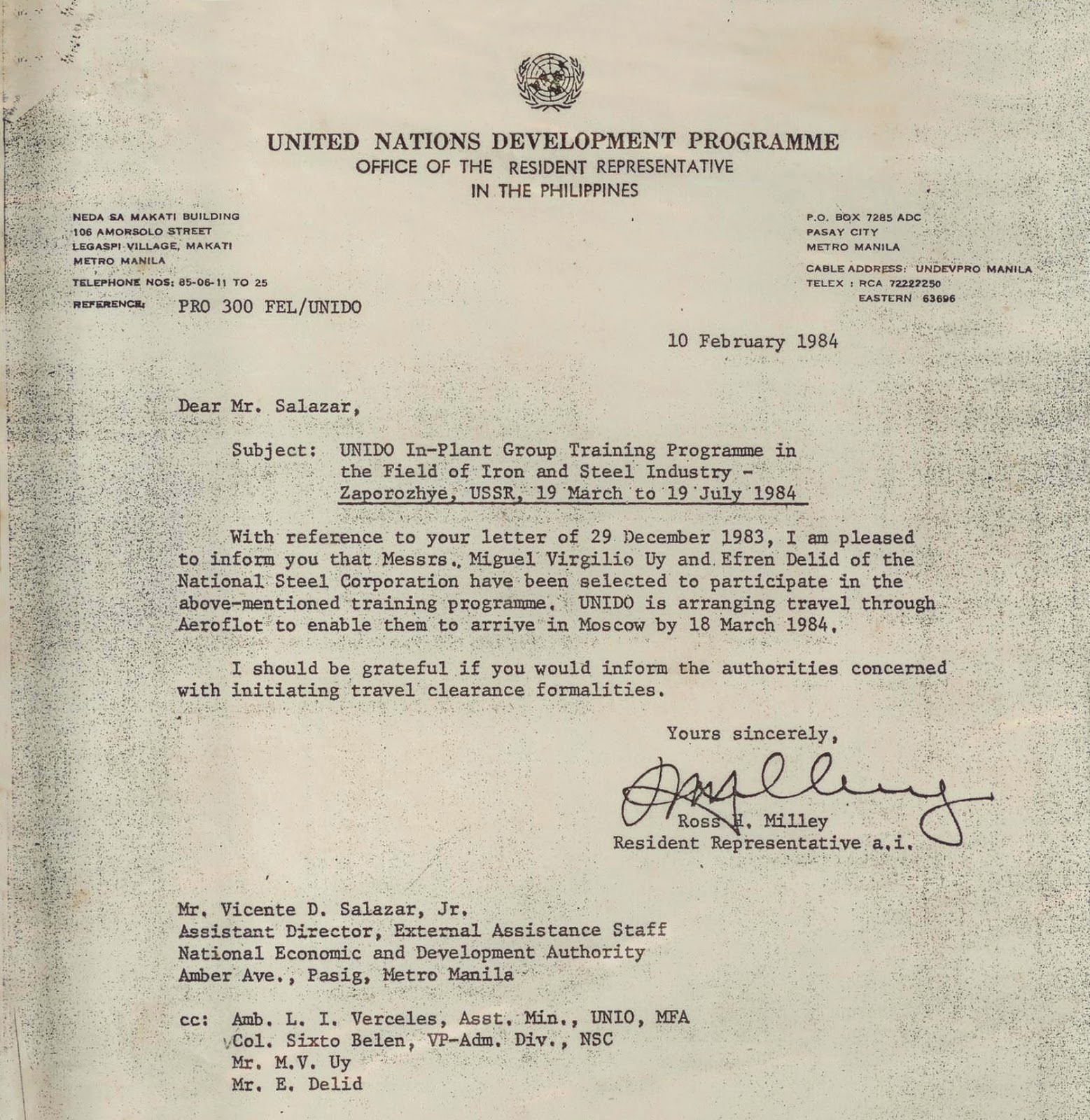
I was then a Senior  Supervisor at Quality Assurance  Dept. Of National Steel Corporation in Iligan City  and together with Mike Uy, also a Senior Supervisor at Hot Mill Operations, we represented the Philippines in  the 27th UNIDO/UNDP  In
- Plant Training  for Iron and Steel Engineers from March 19 to July 19, 1984 at Zaporozhstal Iron and Steel Works in Zaporozhye, Ukraine. While based in Ukraine, our group of 17 engineers from 10 developing countries travelled far and wide the former Soviet territories, by bus, by train, by plane. From the capital Kiev, Krivoi Rog, Zdhanov, Donetsk, Boronets, in the heartland of Ukraine to the western port city of Odessa in the Black Sea, to the Russian region of Liepetsk, Cherepovets, Leningrad in the north and the capital Moscow, we saw its  vastness and  the richness in resources, culture, and history. Most of all, we saw and learned who they are, how different they were, and how they lived in that time.

I first published excerpts of my dairy in the NSC News, the official magazine of National Steel Corporation in 1989, the year Soviet Union was disintegrated into independent states. The recent incidents of conflicts which started last year in Kiev and spilled over to the Crimea region in the Black Sea and now the crisis in the border areas like Donetsk,once again brought back vivid memories of my memorable stay in that wonderful faraway place.


Day 1- March 20, Moscow

“Ladies and Gentlemen, in just a short while, we are landing at the Shereyetmevo International Airport. Time is now exactly 7 in the morning. Ground temperature is 14 degrees below zero”, came the Aeroflot’s stewardess’ final announcement. Suddenly, almost everybody stood up and reached for their overcoats, hats, and gloves. I remained seated, glued to the window. Below, everything was white. I could see Russian airport personnel standing dutifully on guard, in thick fur hats and overcoats, the read insignia blazingly visible from above. Beautiful-just like in the movies.


It was a bitter winter initiation for me. All along the drive from the airport to my hotel, the Rossia Hotel, reportedly Europe’s largest with 3,000 rooms, strategically just a stone’s throw away from the Kremlin Red Square, I have to raise both my feet to fight of the cold seemingly penetrating through my bones. I should have known better, I thought. Napoleon and Hitler learned this the hard way, and with it shattered their dreams of world conquest.’’Mr. Oleg (my guide/interpreter) but I thought it’s already spring time’’, I protested. “Mr. Delid, to the Ukrainians, it’s still winter time. To the Muscovites, it’s now spring time.’’ My first lesson here: for me, they’re just one and the same—Russians.


I slept practically all day. I left Manila the day before with stopovers in Singapore and New Delhi and the long journey took its toll. And for the first time, I learned that Manila time was 5 hours in advance.  The cold weather all the more made it conducive to sleeping. Later, had dinner of chicken and bread with my two Peruvian classmates in one of the hotel’s many restaurants overlooking Red Square. Against the backdrop of the magnificent Kremlin and Lenin Mausoleum dutifully manned by the Red Guards, we toasted for our safe arrival and for the good things to come.


Friday, March 20, 2009

A Day In My Life in Russia


Twenty five years ago today, on March 20, 1984, I arrived in Moscow on a very cold winter morning (7am Moscow time; 12 noon Manila time) to attend the 27th UNIDO/ UNDP Fellowship Program in Iron and Steel Industry at Zaporoztahl Iron and Steel Works in Zaporozhye, Ukraine. I was one of the two engineers representing the Philippines (both of us were from National Steel Corporation in Iligan City) with 15 other engineers from 9 other developing countries attending this 4-month training program. It was my first foreign travel and I traveled alone (my other colleague would follow a week later), and the jitters of experiencing all the firsts in my life I would never forget.

It was a long trip. I left Manila the day before at 3pm bound for Singapore. Here, I would change aircraft, (from Philippine Airlines to Russia's Aerofloat) and had a brief stopover at New Delhi (India) where I was almost left behind. I could not forget the stewardess announcement as we were about to land in Moscow.

"Ladies and gentlemen, in a few minutes, we willl be landing at the Shereyetmevo International Airport. Ground temperature is 10 degrees below zero. Welcome to Moscow."


Below, I could see airport and police personnel on guard, in thick fur coats and hats, the red insignias prominently visible. At the arrival area, for the first time in my life, I felt a sense of helplessness. Nobody spoke English; I could not understand a single Russian word nor comprehend what they were saying. The only word that made sense was "NYET" which I understood to be "NO" because I took out a trolley which the guard prevented me from taking. I was fortunate, a kind European lady helped me in filling out Customs and Immigration papers.

I was expecting and looking for somebody to meet me. But when everyone else had already gone out, I decided to go out also. Just then, a stocky medium height guy approached me and asked "Are you Mr. Delid?" When I answered back, "Yes I am," he offered his hand and introduced himself. "I'm Oleg. I'm from UNIDO. I have come to meet you. Welcome to Moscow." I felt a big big relief.

In the taxi, I asked,"Mr.Oleg, the aide memoir says it's springtime now. But it's still winter." He replied, "Mr. Delid, to the Ukrainians, it's still wintertime. But to the Muscovites, it's now spring." It seemed to me then that Ukraine is far and different from Moscow. Events later will tell that indeed, they are a different people and two different republics.

I stayed in Rossia Hotel, reputedly then, the largest hotel in Europe with 3000 rooms. It was a stone's throw away from the majestic and famous Kremlin and the Red Square. I slept the whole day. In the evening, I joined my classmates from Peru and Yemen for dinner. With the Red Square and Lenin's tomb in the background, we toasted for our safe arrival and wished for our pleasant stay for the next 4 months.

Wednesday, January 28, 2009

The Russia-Ukraine Gas Row and My Russian Diary

The recent feud on gas supply between the Moscow and Kiev governments which threatened and affected Europe's own gas supply amid the cold winter season evoke memories of my unforgettable experience in this once mighty superpower called the Union of Soviet Socialist Republic (USSR). I once attended the 27th UNIDO (UNDP) Training for Iron and Steel engineers in Zaporozhye, (Ukraine), USSR from March to July 1984. I was with a group of 17 other engineers from 10 developing countries and one of the two Filipino engineers representing our country.

It was post Brezhnev and pre-Gorbachev time. Glasnost and Perestroika were then unheard. It was Tavareesh(Comrade) Chernenko's era. When I arrived Moscow on a cold freezing day of March in 1984, I couldn't forget the voice of the stewardess of out Aerofloat flight originating from Singapore with New Delhi as stopover.

"Ladies and gentlemen, we have just landed at the Shereyetmevo International Airport. Ground temperature is 10 degrees below zero.Welcome to Moscow."

In our taxi to our hotel, (the Rossia Hotel, just overlooking the Red Square, at that time was reportedly Europe's largest hotel with 3000 rooms), I was complaining to Oleg, the UNIDO guy who fetched me. "Mr. Oleg, but I thought it's already spring as per the aide memoir!" His answer was strikingly remarkable, as it dawned on me that not all people in the USSR were Russians. "Mr. Delid, to the Ukrainians, it's still winter time. To the Muscovites, it's now spring."

We were based in Zaporozhye, a large industrial city in the southwestern part of Ukraine, with Zaporohtahl Iron and Steel Works as our base plant. This was an integrated steel complex with about 20,000 workers. All throughout our 4-month stay however, we traveled far and wide the soviet territory to such cities as Kiev, Krivoi Rog, Zdhanov, and Odessa, all parts of Ukraine and Moscow, Liepitz, Cherepovets, and Leningrad, all parts of Russia. Many of the largest steel mills in the world were found in these cities. In all of these visits, one of the things that stuck to our minds was the abundance of gas and minerals. So abundant that even in our written and verbal reports and informed discussions, we would then report that there was no such thing as energy conservation there. There was no need for it. They had lots of it; excess in fact. And we were not referring only to our usual enercon programs of shutting down lights and airconditioning when not in use. We were talking about energy usages on big and various reheating furnaces, etc.

I bid goodbye to Russia on a warm sunny afternoon in July 1884. But as I looked out of the plane's window, trying to catch a last glimpse of this beautiful city by the river, I could then sense that in not too far future, something big will happen that will transform again this country, something in the scale when the October Revolution of the early 1900 took place. Finally, when all I could see was a blurred vision of the city, I closed my eyes, took a long deep breath, and silently told myself; "Doshbedanya, Russia. Spaseeba. Spaseeba Bolshoi." (Goodbye, Russia. Thank you. thank you very much.")

That was 25 years ago. Now they have split up into two different nations under different leaders. Obviously, they have to split up too these resources. But they are still interconnected with pipelines that stretch far and wide to Europe. Fortunately enough before the dispute erupted into a full blown crisis, diplomacy worked and the situation hopefully will return to normal as before.